

Quantum computing is often described as the future. But in reality, most companies cannot wait for that future to arrive. They are already facing complex decisions today—decisions that are costly, time-sensitive, and often impossible to solve optimally with traditional methods.
This is where quantum-inspired algorithms come in.
These methods run on classical computers but borrow ideas from quantum physics—such as systems naturally moving toward stable (low-energy) states—to solve complex optimization problems. Instead of checking every possible solution, which quickly becomes infeasible, they guide the system toward better solutions step by step.
This approach becomes critical in real-world problems where decisions are discrete and interconnected. For example, in logistics, planning delivery routes is not just about distance—it involves traffic, time windows, and resource constraints, creating millions of possible combinations. In manufacturing, production scheduling requires coordinating machines, workers, and materials, where a small delay can disrupt the entire system. In energy systems, operators must continuously balance cost, efficiency, and demand under changing conditions.
What all these problems have in common is that the number of possible decisions grows extremely fast. Traditional methods often struggle to keep up.
Quantum-inspired algorithms are designed specifically for this type of complexity. They can handle many constraints at once and explore large decision spaces more efficiently, often leading to better solutions in less time.
In practice, this is already being applied across industries. Companies use these methods to optimize fleet routing and reduce fuel costs, improve factory scheduling to increase throughput, and manage energy consumption in buildings or greenhouses to reduce operational expenses. In finance, they are used for portfolio optimization, where risk and return must be balanced across many possible investment combinations. Even in healthcare research, quantum-inspired techniques are being explored for improving data analysis and classification tasks.
The real value of these algorithms is not just performance—it is structure. They force problems to be formulated clearly, with explicit trade-offs and constraints, instead of relying on ad hoc heuristics. This leads to more transparent, scalable, and consistent decision-making.
At the same time, it is important to stay realistic. These methods are not a universal solution, and their effectiveness depends heavily on how well the problem is formulated. In some cases, classical approaches will still perform better. In others, quantum-inspired methods provide a clear advantage.
Another key point is that these approaches are already aligned with how future quantum computers will operate. This means companies can start solving problems today while preparing for quantum technologies tomorrow—without needing to invest in quantum hardware yet.
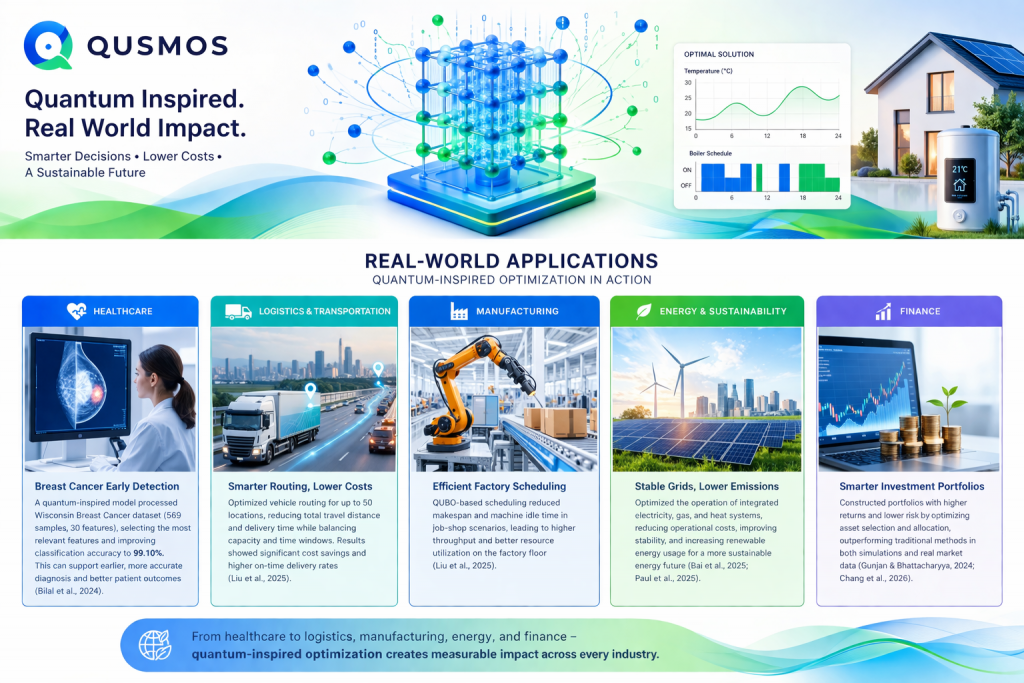
Real-World Applications
Quantum-inspired algorithms are already being explored and used across different domains where decision complexity is high.
In logistics, these methods are used for routing and transport optimization, where the challenge is to evaluate very large numbers of route combinations under changing constraints. For example, quantum-inspired solvers can reformulate routing problems as QUBO models, allowing them to efficiently search through possible routes while respecting delivery time windows and vehicle capacities. Studies have shown that such approaches can reduce operational costs and improve route efficiency compared to classical heuristics (Liu et al., 2025).
In manufacturing, they are applied to scheduling problems, where machines, workers, and materials must be coordinated under tight operational constraints. Here, quantum-inspired algorithms help optimize production sequences by encoding constraints such as machine availability, processing times, and dependencies into a structured optimization model. This allows companies to reduce downtime and improve throughput, especially in complex job-shop environments (Liu et al., 2025).
In energy systems, quantum-inspired optimization is being explored for tasks such as microgrid management and renewable energy coordination. These problems involve balancing multiple competing objectives—such as cost, efficiency, and stability—under uncertainty in demand and generation. Quantum-inspired approaches can model these trade-offs explicitly and optimize control strategies in real time, for example in smart grids or greenhouse climate control systems (Bai et al., 2025; Paul et al., 2025).
In finance, these methods are used in portfolio optimization, where many possible investment combinations must be balanced against risk and return. Quantum-inspired algorithms can encode portfolio constraints and risk correlations into quadratic optimization problems, enabling more efficient exploration of possible allocations. This is particularly useful when dealing with large asset universes and discrete investment decisions (Gunjan & Bhattacharyya, 2024; Chang et al., 2026).
A concrete research example comes from healthcare: studies have applied quantum-inspired optimization techniques to breast cancer datasets (such as WBCD and WDBC). In these works, algorithms are used for feature selection combined with machine learning models like Support Vector Machines (SVMs), improving classification performance by identifying the most relevant diagnostic features (Bilal et al., 2024). These results are promising but remain at the research stage and are not yet standard clinical tools.
Quantum-inspired algorithms are therefore not about the distant future. They are about improving decision-making now—and building the foundation for what comes next.

References
Bilal, M., et al. (2024). Quantum-inspired feature selection for breast cancer classification. Journal of Medical Systems.
Liu, Y., et al. (2025). Quantum-inspired optimization for logistics and scheduling. Applied Sciences, 15(6), 206.
Bai, X., et al. (2025). Quantum-inspired optimization in energy systems and microgrids. Scientific Reports.
Paul, S., et al. (2025). Renewable energy optimization using quantum-inspired methods. Energy Systems Journal.
Gunjan, V., & Bhattacharyya, S. (2024). Portfolio optimization using quantum-inspired algorithms. Handbook of Quantum Computing Applications.
Chang, T., et al. (2026). Advanced portfolio optimization with quantum-inspired techniques. Journal of Computational Finance.